Showing posts with label Google Adwords. Show all posts

Wednesday, August 19, 2009

Local address displayed in Google Ads

For those of you who want to display a specific address on your ads (see example below) you now can on Google Adwords.

The benefits are multiple particularly for those who operate in multiple locations but for most of us the primary benefit is to provide even more information to potential customers before they click through your Adwords Ad. This way customers can self select based on the location of your business.

More information about this feature can be found on the Google Adwords page.

Friday, May 29, 2009

Getting the best bang for buck with Google AdWords

If you were running a business of selling search advertising you'd tell people in these current economic times how to spend less money and get better results, right?

That is exactly what the Google Adwords team is doing at the moment. 

Some would say this is counterproductive and only going to reduce their revenue. However, they'd much rather keep you as an advertising customer than lose you completely or have you spend more of your budget on other advertising media. 

And let's face it when you get right down to it, that is where search engine advertising excels - demonstrating ROI over other options by bringing people who already have an interest in the keyword you are advertising for rather than spraying the message out to a large audience who may have no interest.

The six Adwords tips come with visual prompters (I like them as a way of being clear about the concept in a succinct way) and links to more detailed resources. They are obvious steps you should already be implementing and a few tips thrown in for these economic times and thepublic's changing needs.

Saturday, May 9, 2009

Why would Google and Yahoo offer free online advertising?

Here are the reasons:
  1. They want you to try their services so are prepared to give you an inducement to give it a go.
  2. Advertising revenue is falling worldwide so they are keen to bolster their revenues from new users.
  3. They believe once you have tried the service you will see the value; while it has some short term pain for them they are hoping it has a long term return.
  4. There is very little real cost.
Let's dwell on point 4 in more detail. 

What is the cost of running these campaigns?

Let's look at Google first. So you get a special advertising code that you enter into the Google Adwords site and hey presto you don't have to pay for the first $75 of Adwords ads you place. Google give up $75 and off you go happy. Not quite. 

What are they really giving up for $75? The chance to bill you for the equivalent of $75 of ads you place through Google Adwords. They don't even pay for the ads. But they may well recoup this from others as by your advertising you have increased competition for the keywords you bid on. (Remember they effectively run an auction system where the highest bidder wins). Effectively all they have done is make it nearly $75 more expensive for existing advertisers on those keywords - particularly if you choose high bids because you are inexperienced and want to immediately appear on page 1 for some obvious keywords.

There was an interesting article in the Australian which discusses this concept in more detail.

$75 doesn't last long on Adwords particularly if you could be a serious advertiser.

In the case of Yahoo there seem to be some real costs involved as the process is not automated. The cost of supporting a separate lead gathering process, a phone call to the new advertiser, time and effort on the part of a 3rd party who will construct a campaign. Someone is paying these bills. 

On top of this the apparent value is higher ($150) meaning the campaign may indeed take longer so the costs are likely incurred over more than one month. 

Of course in both offers the real value is determined by unit prices you pay for clicks. If the "cost" of an ad on Yahoo is twice as high as Google for the same work then the actual value will be the same despite the apparent $75/$150 difference. 


PS. I've taken the first step and signed up for the Yahoo Search Marketing deal. It turns out that the company doing all the work is Advantate a joint venture between Melbourne IT and Fairfax Digital that focuses on search engine optimisation and search engine marketing (including both Yahoo and Google). As part of their deal you get a monthly/3 monthly report (it wasn't clear) but you don't seem to get direct access to the Yahoo search marketing interface.

Wednesday, April 29, 2009

Try Google and Yahoo Online Advertising for free $75 and $150 coupon (Australia only)

Good news for those who haven't yet taken the plunge and tried pay per click advertising. Here are two free offers to let you dip your toe in the water without risk and see if your business has anything to gain: 


A $75 free Google Adwords coupon for new Google Advertisers. Expires 30/6/2009.


The lesser of $150 or 3 months free advertising on NineMSN and Yahoo7 for new Yahoo advertisers. Expires 31/7/2009.

Why not give it a go and see how you find it? I'm interested in how easy you find it. I'm even going to finally try Yahoo advertising. What have I got to lose?

Sunday, April 19, 2009

Click fraud or just a poor Adwords campaign?

Here is a specific example of a campaign I have been struggling with for a few months. It relates to a specific condition (endometriosis) that afflicts a significant part of the female population. 
The suspicion has been that this is an example of where competitors or website owners are deliberately clicking on the high value ads. Why would they do that?

Competitors may do it to increase my costs or turn me off advertising for that keyword. It simply becomes hard to justify the return on investment for that keyword. Site owners who place Adwords ads on their site have an incentive to have visitors click as many ads as possible as they get paid for each click. It should be pointed out that both of these practices are certainly unethical and are likely to also be illegal and may lead to a site owner or advertiser being banned from using Adwords.

Detecting click fraud

Actually identifying click fraud can be difficult. This issue generates a lot of angst amongst all the big online ad distributors and has also lead to substantial payouts to advertisers where it is detected. 

A simple way of doing it is to look for dramatic changes in performance of your ads over time. This requires you to actively monitor your Adwords performance and factor out the effect of any specific campaigns or recent changes you have made. Look for:
  1. An abnormal number of clicks from the same IP address.
  2. Keyword performance - a sudden increase in CTR (often with higher bounce rates or lower average time on the site).
  3. Decline in the number of conversions or rate of conversion.
  4. An increase in the number of visitors who leave your site quickly
  5. A large number of impressions, without the accompanying click on your ad - this may be an attempt by a competitor to artificially lower your CTR and as a result your quality score (so you may pay more for a page 1 listing or not appear at all).
  6. Abnormally high clicks and impressions on affiliate websites
  7. A large number of clicks coming from countries outside of your normal market
Our Case

Endometriosis is a fairly well searched term (the cost per ad is high in Adwords which is another indicator of advertiser interest), it is in the top 20 pages of the OGCG website that generates traffic from Google and a few local competitors advertise heavily on the term. So, with my knowledge and skill I should be able to turn it into a productive term.

Well, no. I've had to turn off advertising for the keyword "endometriosis". 

You can see from statistics below that it has a low click through rate (CTR) and a high cost per conversion. It simply doesn't justify the expenditure. In our case I'd be loathe to call it click fraud but the results are just not what one would expect for such a prevalent condition. This is the second time around I've tried to identify a productive niche. Perhaps I need to accept the keyword isn't as specific of an intent to seek treatment as I believed.

(Click to Enlarge)

You can find out more about click fraud on wikipedia.

Friday, April 10, 2009

Online Money Making Schemes: Stick to your knitting

You may be tempted to try to "monetise" your medical website like so many other sites on the internet with advertising or selling products related to your practice. This is a really bad idea.

It is a bad idea on three levels.

Firstly, it compromises your integrity and impartiality - patients may think you care for money more than them.

Secondly, it brings you into company with those who sell pills, potions and poultices. The internet is riddled with them and while they might be popular there is little proof of their efficacy.

Finally, it is just not worth your time. For most medical services the unit cost of your services (and measure of profit) far exceeds any revenue you would receive.

For example:

Adsense - Google Advertising

Cost: Free, just your time and it will take you less than an hour to set up your AdSense account and place it on your medical website.

Revenue: Revenue is a function of the number of people that click on ads on your website and what Google will pay you when someone clicks on that ad. What does that mean in practice? Using this simple formula:

Monthly revenue = Visitors to your website during a month * % that click thru * average payment per click.

If you don't know these figures use the following estimates:
Visitors: 1,000 a month (this depends on the popularity of your medical website)
Click through rate: 3% (this depends on where you place ads, the quality of your content and the format of the ads)
Cost Per click: This is the hardest figure to find, and really depends on what people are prepared to pay on the web. Note you only receive a percentage of what you would pay to advertise for those keywords yourself.

1,000 visitors a month * 3% click through * $0.25 per ad = $7.50 - not much money!

Working backwards to earn $100 a month and assuming the same click thru and clicked ad payment you would need 13,333 visitors to see your site. You aren't going to get that unless you have some serious content - but even if you do it is the same profit as perhaps seeing patients for a session a day?

All in all a poor investment of your time and effort.

And of course in the process you'll be directing people to click on ads of your competitors or worse some inaccurate quackery.

Friday, February 20, 2009

Google Adwords - Summary Page


Author: Google
Site: adwords.google.com
Features:
  • Attract new customers
  • Appear on first page of Google search
  • Advertise on websites that use Google Adwords
  • Control your advertising budget
  • Target particular demographics
  • Advanced reporting and analysis

Subscribe to Google Adwords posts only.

See below for posts on this topic.

Friday, January 30, 2009

How to make you Google Adwords ad stand out from the crowd

Here are three ways to visually enhance a Google Adwords entry to make it stand out from the crowd. Two of these techniques give you an advantage through an additional line in your ad copy.

1. Keyword Highlighting

Set up your Google Adwords campaign so that the ads that display when someone types in a keyword trigger an ad that uses that search term. Every instance of that term will be highlighted when someone searches for it.

The figure opposite shows the search dentist sydney which shows up a number of ads highlighting the occurrence of either word: in the title, in the copy and even in the display URL.

If I had searched for the literal "dentist sydney" ie requiring both words to be used together then only the 2nd and 4th ads would have had their title highlighted as both words occur in the ad. Similarly if I had searched for "sydney dentist" then the URL of the 5th ad would have been highlighted.

2. Additional line for regionally targetted ad

When you are setting up an Ad you can geographically restrict it to display to certain users eg choose to display your ad in Sydney only or in Australia or the US etc. This obviously restricts the audience that will see your ad but perhaps that is a sensible trade off to make if they are really the only people likely to visit a bricks and mortar store.

In the example opposite only two advertisers have taken advantage of this and they get the benefit of an extra line for their ad that highlights that they service that area.

How does Google do this? When a user enters a search term that is obviously geographically related or the IP address (a part of information that is sent when you do a search) of the computer performing the search indicates the user is located in a particular geographical location your ad would be triggered. See more about it here.

3. Additional line and call to action with Google Checkout button

If you have a product or service you can sell using Google Checkout (Google's equivalent to PayPal) then you can achieve the effect  shown on the right - a nifty little call to action button with Google branding that asks your customers to check out.

Google says these help attract new customers and include a testimonial from a customer claiming a 23% lift in click through rate as a result.

Google checkout is a beast in itself and you should ascertain whether you are really ready to take credit card information over the internet.

Conclusion

These are all ways of getting a very visually differentiated Ad.  Will this make your ad more effective? Probably. Other methods to increase the effectiveness of your ad include paying attention to the wording of your ad. Are you using words that draw the potential customer in?  Is your Ad copy evoking an emotional response? Below is the kind of tips typically suggested to do just that. I can't see someone using the words 'humiliate' or 'fatal' in a medically related ad though!


Tuesday, November 11, 2008

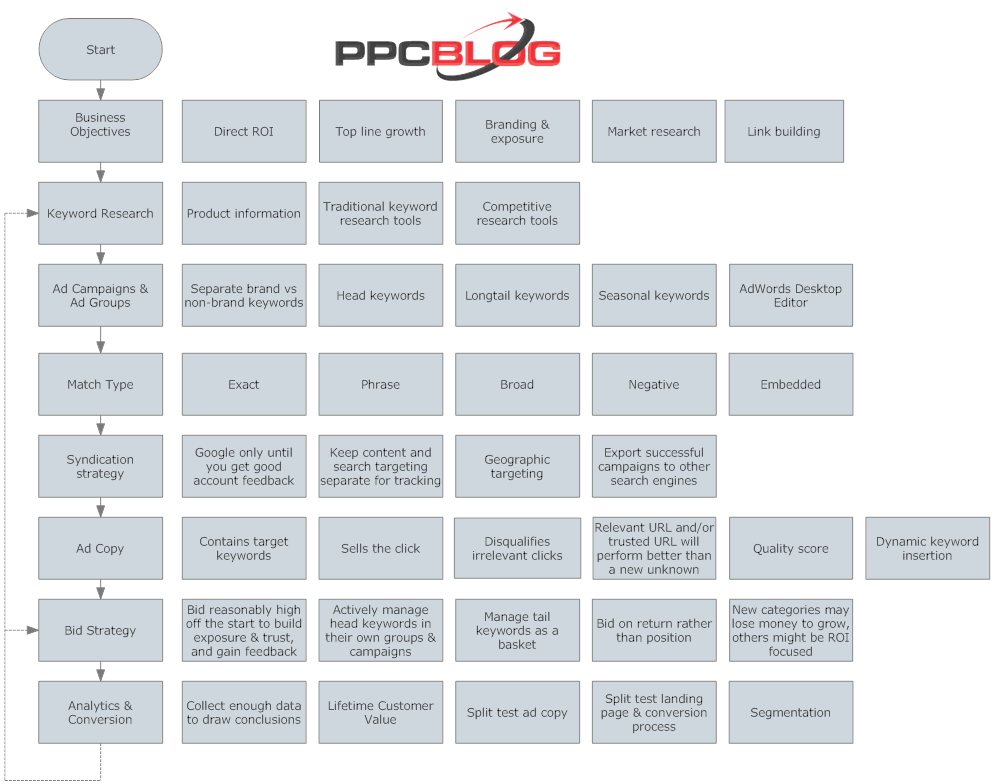
Steps to a Pay Per Click campaign: Flowchart

This flowchart (authored by PPCBlog) is really neat and thought I'd share it with you all.

I think it is a great way of representing the steps involved in PPC advertising and the considerations at each step. Like most things to get a return you need to put in continuous effort to ensure you are getting the best return on your investment.

(click the graphic to see it clearly)


Sunday, November 9, 2008

Doing without Adwords: Traffic up 10% but calls down

Apologies. I've been overseas for a month but while I was away I set up another test: I scaled down our Adwords advertising to see what, if any, impact it had on visitors and also people calling the practice.

Bottom line was: a) a noticeable difference in people calling and b) about a 10% increase in traffic. What? Yep, I spent less money and received more traffic. How? Well obviously the site is picking up and doesn't necessarily need help from advertising.

That hypothesis doesn't fit however with the reduction inbound calls. Inbound calls/bookings is the only real measure of the effectiveness of our advertising (remember we don't sell anything online or get people to register - our call to action is to ring a phone number). Although I don't have empirical data to back up how much less phone calls were made it does demonstrate that all web traffic is not equal. If the aim of marketing is to generate as many high quality leads as possible (rather than just raising awareness) then it is not enough to just bring anyone to the website.


Using Webmaster tools to dig deeper into how traffic has increased 10% showed that:
  • organic search +70%
  • pay per click (Google) -45%
  • direct -5% (this was probably me not visiting the site as much)
So yes, there really was a big reduction in pay per click visitors but this was more than offset by an increase in organic search. Now I really need to understand why organic searches have improved so dramatically. Perhaps it was all the additional content we added in late September meaning the site appears more often when people search. Unfortunately it also shows that these visitors don't necessarily translate to callers - at least not immediately.

The bottom line is I've reinstated the advertising but it is good to know we are generating more traffic organically without it.

Saturday, September 27, 2008

Google Contextual Advertising - an example

Let's now have a look at what you can do by expanding your Google Adwords advertising a little further afield - through advertising on Google's content network.

Here's my results for www.ogcg.com.au.


Search Advertising

For a start there is an even distribution of searching across the OB and GYN groups with a slight increase in the PR group. The Cost/Conversion rate is also better in the GYN group compared to the OB group - perhaps less competition so cheaper advertising. Also note the incredibly small click thru rate for the PR group. There may be several reasons for this: the text to the Adwords ad is very specific about seeing a medical professional, the ad might not be well targetted or people may be after something specific that they don't believe the website would provide. The cost per conversion is also terrible: 7-14 times worse than the GYN and OB groups.

Perhaps it is not worth advertising using the PR group terms (or not all the terms in the group).

Let's compare the Ads delivered via Google Search to those delivered through Google's content network - ie across websites that have AdSense advertising.

Content Advertising

Contextual Advertising (placement) enables you to have your ad displayed on other people's websites who use Google's Adsense system. Google claims your ad may appear on millions of pages across the web.

Visitor Analysis

Looking at our data you can see a very different distribution of terms with contextual advertising - in the case of the GYN and PR groups the ad generates between 2 and 6 times the impressions that Search advertising does. This shows that not everyone uses Search all the time.

Quite often people are visiting a website eg perhaps if they are pregnant they might already know which site they want to go to and spend a lot of time there. I'm sure the same is true of most areas of medicine and the web in general - people seek information first but also a sense of community and a website is a collection of information and people around the theme of that website. This however doesn't necessarily mean they are more likely to purchase something.

Click Thru Rate (CTR)

Notice next how the CTR is much reduced. This is probably because people were doing something else at the time. Who looks at Ads when they are in the right place? Also perhaps for a content rich site the ad may be displayed on several pages a visitor clicks through while on the site. After first noticing the ad it is probably likely to be ignored on subsequently page visits.

Cost Per Conversion

Here is a strange one though: the cost per conversion is much lower. Why would this be? I think this is primarily influenced by the price I put on the keywords in the first place. I pay a flat rate for contextual ads but often have to pay more for search advertising. Perhaps there is also less competition meaning you are charged less.

Placement on specific sites vs general contextual advertising

Finally, you can choose to either place your ads on particular sites or let Google place it across all pages where your terms are relevant. Looking at our results you will see that never have the sites chosen delivered better results than the untargetted contextual advertising even when we are getting many more visits.

Why is it so? I suspect the placement algorithm used by Google puts your ads across a much more relevant group of pages than just picking certain websites.

Is Contextual Advertising worth it?

Overall I'd have to say we are pleased with the results from contextual advertising - it has enabled us to reach potential customers we could not reach before at a cheaper cost than search advertising.

Remember that periodically you need to perform your own analysis of your data, make hypotheses and test and change as a result of what you learn. Think of it like investing - just splashing money around is unlikely to achieve optimum results.

There are several limitations of this analysis. Feel free to point them out.

Saturday, September 20, 2008

Using Google Adwords to Size Your Potential Market

Google Adwords (and similar tools) can provide incredible insight into the potential market you are not reaching. Why? Because it allows you to get access to a page 1 listing on Google and also contextual advertising on a whole range of directories and content sites without spending up big. Why is that important - well it allows you to size your total potential search market - after all everyone sees page 1. You can then use this data to get some key insights into how you can attract more visitors through organic search (ie not paying).

Let's demonstrate the principle by looking at some more real data.


This data was collected over a recent full month of Adwords advertising. I've rounded the results and also averaged them to express all traffic measures as visits per day - this makes it easy to compare to other statistics about visitors per day. The numbers are also quite low as we do very specific targetting of our market. I have three separate grouping of advertising words let's call them pregnancy (PR), gynaecology (GYN) and obstetrics (OB). By multiplying out the visits per day by the CTR you can see that on average I'm getting about 10 visitors per day through Adwords.

Calculating visitors per day

So using these stats indicates that if you optimised for all the words in my groups you could have about 1550 visitors per day! This is of course not going to happen as not everyone is going to click thru.

What click thru rate to apply

Applying the click thru rates (CTR) from my advertising campaigns shows you could get about 10 visitors per day (just multiplying out the stats). Doesn't sound great does it? Well, more visitors will visit you if you are listed on the search results compared to advertising (although I'm saying nothing about the quality of your customers). Remember the stats I showed about click thru on page 1?

Basically you can expect 3-42% of traffic to visit your site depending on your position on page 1. Applying these statistics to my data you'd get 47-650 visitors per month from search. The higher your listing in the rankings the more visitors you'd get.

How would this increase traffic?

These stats show you can increase your visitors by 4-65 times (from my 10 per day stats) through search optimisation. What value do you put on this traffic? That will depend on how your visitors convert into paying customers.

How much money is this saving you on advertising?

If the average cost per click is $1 then this is saving you between $4 and $65 per day. (Not that you're likely to see the same volume of traffic per day through Adwords as it has lower click thru rates).

Summary

You can use the same approach with your own campaigns. The approach in summary is:

1. Possible Visitors per day =
Average Adwords visitors per day x Click thru rate for page 1
eg (500 + 500 + 550) x 3% for lower bound and (500 + 500 + 550) *42% for upper bound giving a range of = 47 to 650 clicks per day

2. Value of Page 1 listing =
= Possible Visitors per day * Average cost per click
= 47 * $1 for lower bound and 650 * $1 for upper bound

Final Notes:

You may find while your visitors increase your conversion rate drops through native search engine ranking as you may attract a lot more information seekers rather than potential customers.

Don't forget that Adwords reach is actually wider than Google Search so you won't be able to completely kick the Adwords habit.